D
Darren McLean
Guest
- Thread Author
- #1
Nakhchivan Travel Guide
This is a Nakhchivan Travel Guide from taste2travel.com
Date Visited: March 2026
Introduction
Welcome to my Nakhchivan Travel Guide – your companion to one of the most unique and lesser-known regions of Azerbaijan and the Caucasus.

Stormy skies, over the turquoise-coloured domes, of the Heydar Mosque in Nakhchivan City.
Nestled between Armenia, Iran and Turkey, Nakhchivan is a land of dramatic mountains, ancient monuments and deep-rooted traditions.
From the ancient sights of Nakhchivan City, including Noah’s Mausoleum, to the spectacular landscapes of Alinja Castle, the region offers a journey through centuries of history and culture.

Nakhchivan city is the capital of the Nakhchivan Autonomous Region.
People often describe Nakhchivan as the “Land of Noah” because of its long association with the biblical and Quranic story of Noah.
Nakhchivan City serves as the capital of the Nakhchivan Autonomous Republic, an exclave of Azerbaijan that Armenian territory separates from the rest of the country.

Blossoms, and Noah’s Mausoleum, in Nakhchivan city.
Whether you enjoy Silk Road history, architecture, natural landscapes or authentic local experiences, Nakhchivan has plenty to offer.
The region is small but fascinating. Rugged mountains and dry plains frame the landscape, while ancient mausoleums, historic fortresses and legends passed down through generations add to its appeal.

The newly constructed Heydar Mosque is the largest mosque in Nakhchivan.
Quiet and largely untouched by mass tourism, Nakhchivan offers travellers a glimpse of a lesser-known crossroads of the Caucasus where culture, nature and history meet.

The ultimate step-exercise workout awaits in Nakhchivan – the 1,500 stone-step climb to Alinja Castle.
If you enjoy visiting unusual destinations and places that remain well off the established tourist trail, Nakhchivan is well worth exploring.
Location
Nakhchivan is an autonomous region of Azerbaijan in the South Caucasus.
Armenian territory separates Nakhchivan from the rest of Azerbaijan, making it an exclave.

Nakhchivan is an exclave of Azerbaijan, bordered by Armenia, Iran and Turkey.
The region borders Armenia to the east and north, Iran to the south and southwest, and Turkey to the northwest.
The land border between Turkey and Nakhchivan is only 17 kilometres (11 miles) long. Despite its short length, it is Azerbaijan’s only land border with Turkey and is an important strategic connection.
Located along historic trade routes near the Aras River valley, Nakhchivan sits at a natural crossroads between the Caucasus, Anatolia and the Middle East.

Nakhchivan City lies in the foothills of the Zangezur Mountains, at an elevation of about 873 metres (2,864 feet) above sea level.
The Zangezur Mountains form part of the larger Lesser Caucasus mountain system. They extend for roughly 130 kilometres (80 miles), mainly along the border between southern Armenia and southwestern Azerbaijan.
Nakhchivan has a dry continental climate, with hot summers and cold winters. The climate contributes to the region’s distinctive landscapes and flora.
People

A friendly butcher in rural Nakhchivan who served me a delicious lunch of roast chicken.
The population of Nakhchivan is predominantly ethnic Azerbaijani.
I found the people to be warm, welcoming and friendly.
Turkic heritage, Islamic traditions and local customs passed down through generations shape daily life. Family ties, respect for elders and community life remain important parts of local culture.

With a capacity of 5,000 worshippers, the modern Heydar Mosque is the largest mosque in Nakhchivan.
It was a pleasure to spend time with the people of Nakhchivan.
In terms of religion, Nakhchivan is overwhelmingly Muslim, with most Muslims following the Shia branch of Islam and a smaller Sunni population.
The region has a strong cultural and historical connection to Islam, while Azerbaijan as a whole is a secular state.
Flag
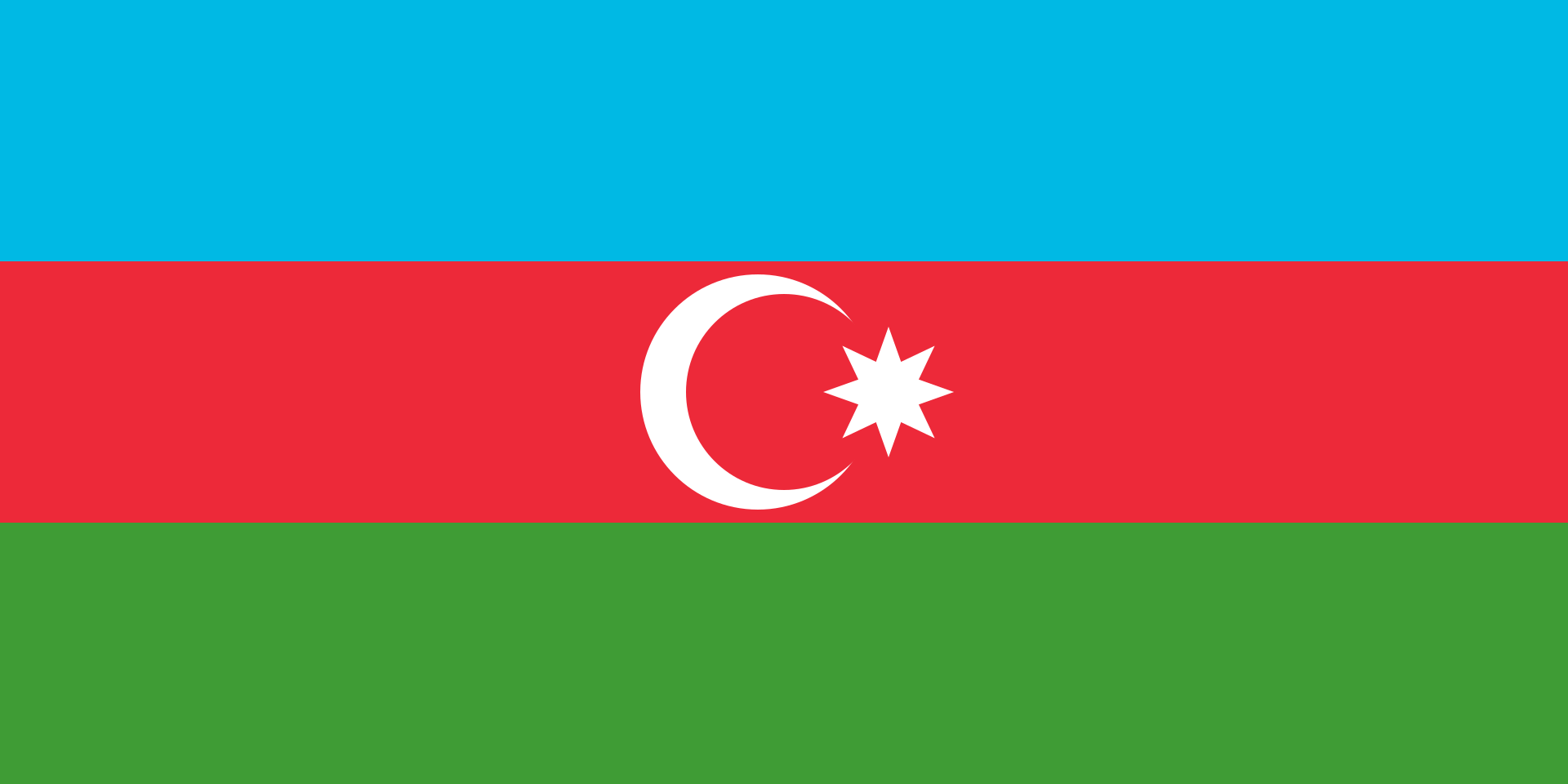
The flag of Azerbaijan.
Nakhchivan does not have a separate official regional flag.
According to the Constitution of the Nakhchivan Autonomous Republic, the official flag is the national flag of Azerbaijan.
The Azerbaijani flag consists of three horizontal bands of light blue, red and green.
- Light blue: represents Turkic heritage.
- Red: represents progress and the development of Azerbaijani culture.
- Green: represents Islam.
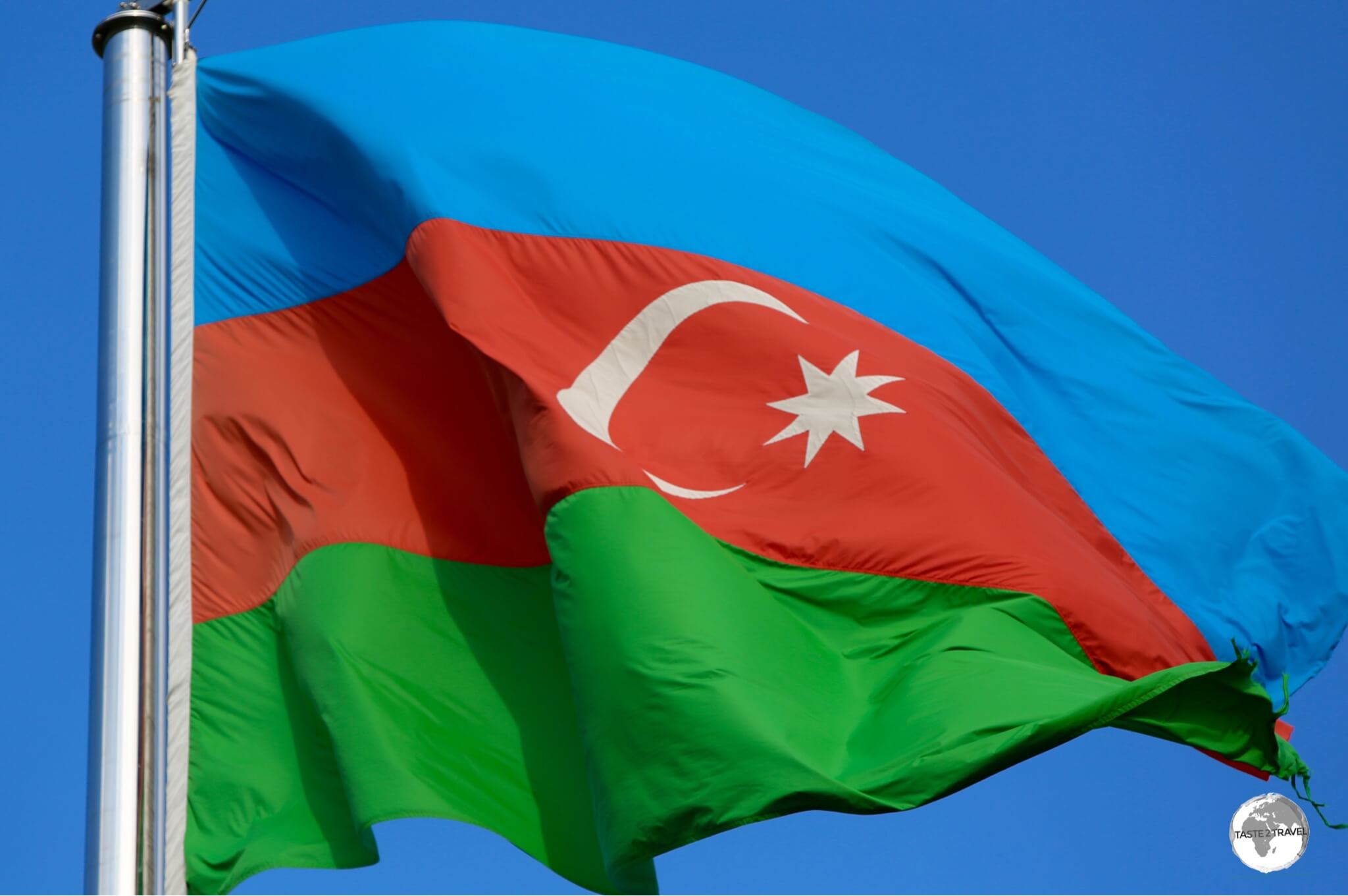
A gigantic Azerbaijan flag flying in downtown Baku.
A white crescent moon and an eight-pointed star are displayed in the centre of the red band.
The eight-pointed star is commonly associated with the eight letters of “Azerbaijan” when written in Arabic script.
Now that you know a little about the flag of Azerbaijan, you have the answer to at least one of the questions in my Crescent Flags of the World travel quiz.
Good luck!
Unofficial Regional Flag

Nakhchivan does not have an official regional flag. However, a different design appeared during pro-Azerbaijani independence rallies in 1990.
The unofficial design was based on the Azerbaijani flag. The green stripe and white star and crescent were replaced with yellow, and the proportions of the stripes were changed.
Although it was never adopted as an official flag, the design was widely reported as a “Nakhichevan” flag.
Currency
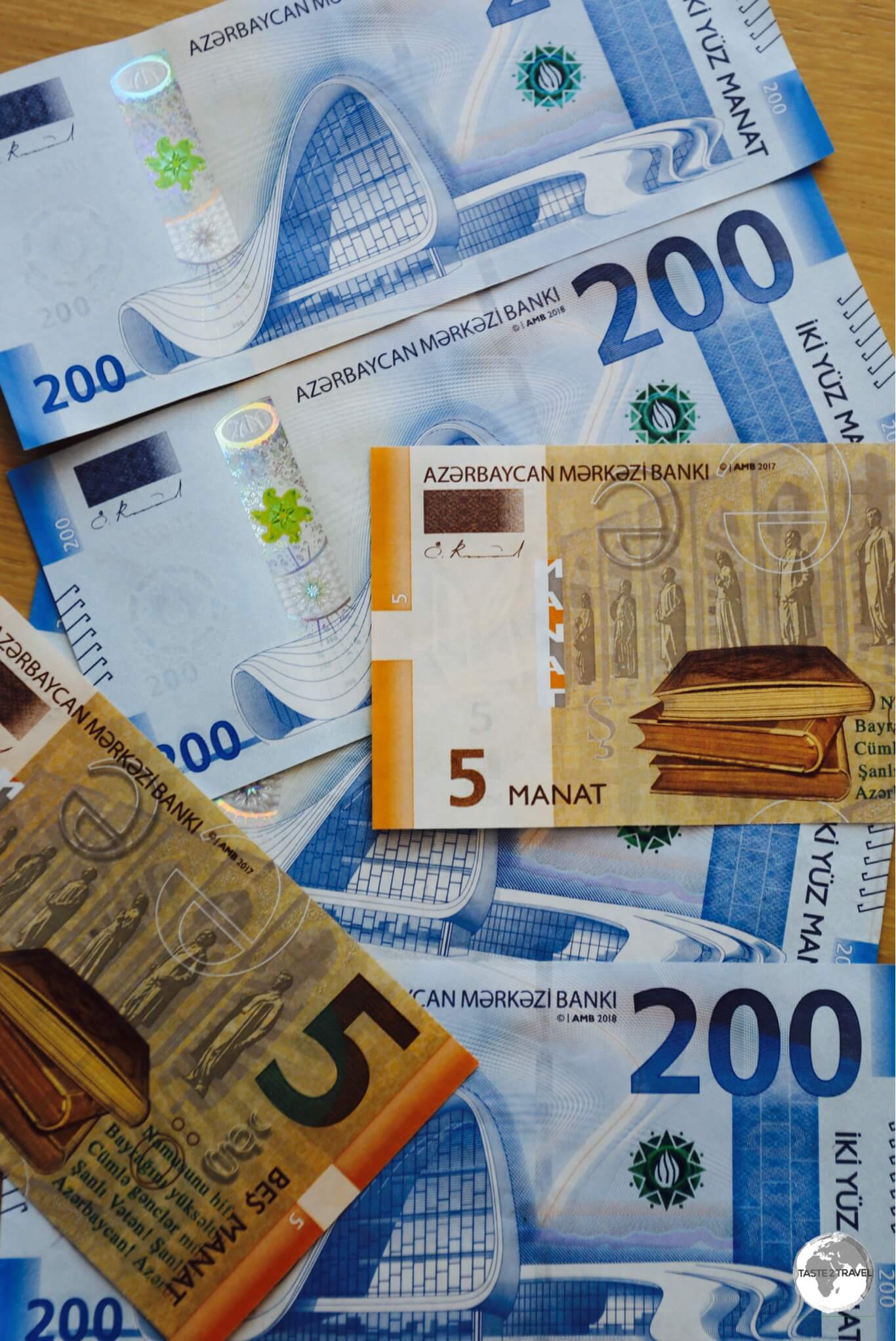
As a part of Azerbaijan, the currency of Nakhchivan is the Azerbaijani Manat.
As part of Azerbaijan, Nakhchivan uses the Azerbaijani Manat (AZN).
The manat is the official currency of Azerbaijan. Its symbol is ₼.
Manat banknotes were designed by Austrian artist Robert Kalina, who also designed the euro banknotes.
Banknotes are issued in denominations of 1, 5, 10, 20, 50, 100 and 200 manat. Coins range from 1 to 50 qapik.
A 500-manat commemorative note also exists.
The manat symbol is a stylised lowercase “m” that resembles a clockwise-rotated euro sign.
Exchange Rates
Approximate exchange rates at the time of my visit in March 2026 were:
- US$100 = AZN 170
- €100 = AZN 201.62
Exchange rates change, so check the current rate before travelling.
Credit Cards
Credit cards are accepted at major hotels, supermarkets and some restaurants in Nakhchivan City.
However, cash is still king elsewhere.
You will need cash for taxis, small shops and the local bazaar.
ATMs
ATMs are available in downtown Nakhchivan.
They are less common in rural areas, so it is a good idea to withdraw enough cash before travelling outside the city.
Costs
Travel costs in Azerbaijan are generally moderate and affordable compared with Western Europe.
Your daily spending will depend on your travel style, but a useful guide is:
- Budget traveller: US$40–60 per day
- Mid-range traveller: US$70–120 per day
- Luxury traveller: US$180+ per day
Sightseeing

Home to 95,000 souls, Nakhchivan City is the capital of the region of the same name.
Nakhchivan City has deep historical roots and is surrounded by mountains, historic monuments and religious sites.
According to local tradition, the city was founded by Noah after the Great Flood. This adds to the area’s strong connection with the story of Noah.

A view of the Heydar Mosque in Nakhchivan City.
I stayed for three nights, which was not long enough to see everything.
I would recommend six to seven days in Nakhchivan if you want to explore the city and the many attractions outside it.
There are plenty of sights that I did not have time to visit, so I will have to return for another trip.
Alinja Castle

A highlight of Nakhchivan is Alinja Castle, a dramatic mountain fortress often called the “Machu Picchu of Azerbaijan” because of its steep terraces and spectacular setting.
The fortress dates back at least to the early medieval period, although its exact origins are uncertain. It was expanded and strengthened over time.

Located at 1,700 metres above sea level, Alinja Castle offers panoramic views of the surrounding countryside.
Alinja served as a defensive stronghold, a treasury and a refuge for regional rulers. It also became a base of resistance during invasions.

Even this lounge lizard was able to haul himself up the 1,500 stone steps to take in the amazing view.
The castle sits on Alinja Mountain, at about 1,700 metres above sea level. A steep stone stairway climbs the mountain to the ruins.
The position made Alinja naturally defensible. Sheer cliffs protect much of the mountain, while the long, winding stairway provides access to the fortress.
Stairway to Heaven!
Climbing to the top involves around 1,500 stone steps. Fortunately, the steps are solid and well maintained.

The red line shows the approximate path of the stone stairway which leads up to Alinja Castle.
Even this lounge lizard managed to climb the 1,500 stone steps to the top!

“A journey up 1,500 steps begins with the first step” is not something Mahatma Gandhi every said.
The effort is rewarded with sweeping views across the Nakhchivan countryside.

A view of the steep, windy stone stair case which climbs up a narrow gorge to Alinja Castle.

Climbing up to Alinja Castle with the museum visible in the valley below.
Alinja is not a single building. It is a complex of terraces, defensive walls and fortified levels built into the mountainside.

Strategically located, Alinja Castle famously held off an invasion by the marauding conqueror – Tamerlane – for many years.
The best photographs are from the summit citadel, which requires a further short climb above the main ruins.
The mountain itself forms much of the fortress’s defence, making a direct assault extremely difficult.

The climb up to Alinja Castle offers spectacular views of the Nakhchivan countryside.
In recent years, the site has been partially restored, with improved stairways and pathways for visitors.
Alinja Castle Museum

The Alinja Castle Museum is a good starting point for any visit to the castle.
The Alinja Castle Museum is located at the bottom of the mountain and is a good place to begin your visit.

The Alinja Castle Museum explains the history of this important sight.
The museum explains the history of the fortress and displays artefacts discovered during archaeological excavations.

Display’s at the Alinja Castle Museum include artefacts found during archaeological excavations.
From the museum, you can look up at the ridge and see the long stairway leading towards the fortress.
Knowing that there are 1,500 steps ahead gives you some idea of what awaits!
Ilandagh

The iconic “Ilandagh” is a legendary 2,415-metre cleft peak which dominates the local landscape.
In the distance, the distinctive peak of Ilandagh can be seen from Alinja Castle.
This 2,415-metre mountain has a dramatic cleft summit and is often referred to as “split mountain”.
Ilandagh is associated with the legend of Noah’s Ark. According to local tradition, the split in the summit was caused when Noah’s Ark passed over the mountain.
Getting There
The stairs to Alinja Castle begin from the Qazançı road, around 33 kilometres northeast of Nakhchivan City.
A couple of daily minibuses to Xanəgah pass within about one kilometre of the castle.
A return taxi from Nakhchivan City should cost up to around AZN 50, depending on the waiting time.
I drove to the castle in my rental car, which was straightforward and convenient.
Noah’s Mausoleum

Noah’s Mausoleum is an historic and symbolic monument located in the city of Nakhchivan.
Located alongside Narin Kala, Noah’s Mausoleum is an historic and symbolic monument in Nakhchivan City.
The site is traditionally believed to mark the burial place of Noah, although this identification is based on local legend rather than confirmed historical evidence.

A decorative door lintel at Noah’s Mausoleum.
The site has a long and complex history. Its origins are often linked to the early medieval period, and it later became part of a larger religious complex and pilgrimage site.
For centuries, local communities regarded the site as sacred.

A stormy view over Nakhchivan from Noah’s Mausoleum.
The original structure was destroyed in 1953 during the Soviet period.
The current mausoleum was rebuilt in 2006 as part of a restoration project.

Noah’s Mausoleum in Nakhchivan City.
The building is octagonal and topped by a conical roof. It incorporates remnants of the earlier structure.
Inside is an underground burial vault, or crypt. Unfortunately, it was closed during my visit.

Noah’s Mausoleum is an octagonal building with a conical roof.
The mausoleum is both a religious shrine and a cultural monument.
The belief that Noah lived and died in this region is deeply embedded in Nakhchivan’s identity. The region is sometimes called the “Land of Noah” because of this tradition.

According to local legend, Noah lived and died in Nakhchivan.
At the same time, several places across the Middle East claim to be Noah’s burial site. The connection with Nakhchivan should therefore be understood as symbolic and legendary rather than archaeologically proven.
Narin Kala

Located next to Noah’s Mausoleum, Narin Kala (Small Fortress) is an ancient fortress that was fully renovated in 2013.
At the centre of the square enclosure is a museum housed inside a round building.
Entrance to the museum is free.

Azerbaijan flags at Narin Kala.
The displays contain historical exhibits relating to the fortress and the surrounding area.
Heydar Mosque

The modern Heydar Mosque is one of the largest mosques in the South Caucasus.
Adjacent to Noah’s Mausoleum, Heydar Mosque is one of the largest mosques in the South Caucasus.

A view of the Heydar Mosque, the largest mosque in Nakhchivan.
The mosque became fully operational in 2023 and can accommodate up to 5,000 worshippers.

Stormy skies over the Heydar Mosque in Nakhchivan.
It was built in the early 21st century and named after Heydar Aliyev, the former President of Azerbaijan.

Completed in 2023, the Heydar Mosque can accommodate up to 5,000 worshippers.
The mosque features a grand, symmetrical design inspired by classical Islamic architecture, particularly styles found in the wider Middle East and Anatolia.

The Heydar Mosque in Nakhchivan.
A large central dome, twin minarets and a spacious prayer hall dominate the design.

The central dome of the Heydar Mosque.
Momine Khatun Mausoleum

Dating from 1168, the Momine Khatun Mausoleum is one of the most celebrated medieval monuments in the Caucasus.
The Momine Khatun Mausoleum is one of the most celebrated medieval monuments in the Caucasus.
Dating from the 12th century, it is renowned for its refined geometry, intricate decoration and historical importance.
The mausoleum was built by the prominent architect Ajami Nakhchivani, who is regarded as a master of the Nakhchivan architectural school.

A sculpture park, featuring ancient stone rams, sits alongside the mausoleum.
It was commissioned by the ruler Jahan Pahlavan in memory of his wife, Momine Khatun.
The mausoleum is a striking, ten-sided tower that rises about 25 metres.
It stands on a solid base and tapers slightly upwards, creating a strong sense of vertical elegance.
Key features include geometric brickwork, turquoise-glazed tiles, Kufic inscriptions and an underground burial chamber.
The monument is more than a tomb. It is a sophisticated architectural work that combines art, mathematics and spirituality.
At the time of my visit, the mausoleum was closed because of restoration work.
Jame Mosque

The Jame Mosque dates from the 18th century.
One of Nakhchivan’s charming historic sights is the Jame Mosque, located in downtown Nakhchivan.
The mosque was built in the 18th century by Muhammad Tagi and is known locally as the “City Mosque”.

The interior of the Jame Mosque in Nakhchivan.
It played an important role in the social, political and religious life of the city before the Soviet era and continues to serve the local community today.
One of the highlights is the mosque’s colourful shebeke windows.

A highlight of the Jame Mosque are the colourful shebeke windows.
Shebeke is a traditional style of decorative window made using coloured glass.
For more information about shebeke, including photographs of an artisan making a window, see the Shebeke section of my Azerbaijan Travel Guide.
Yusif ibn Kuseyir Mausoleum

The Yusif ibn Kuseyir Mausoleum in downtown Nakhchivan.
Located on a quiet back street in downtown Nakhchivan, the Yusif ibn Kuseyir Mausoleum is one of Azerbaijan’s important medieval monuments.
It is also a striking example of early Islamic architecture in the Caucasus.
Built in 1162, the mausoleum was designed by the renowned architect Ajami Nakhchivani, who also designed the Momine Khatun Mausoleum.

The Yusif ibn Kuseyir Mausoleum is located in a quiet back street of Nakhchivan City.
The monument commemorates Yusif ibn Kuseyir, who is believed to have been a local noble or religious figure.
The structure has a distinctive ten-sided shape and a conical roof.
It rises in a tower-like form and is constructed mainly from baked brick.
The exterior is richly decorated with geometric patterns, Kufic inscriptions and ornamental brickwork.
The inscriptions include verses from the Quran and the name of the architect.

The Yusif ibn Kuseyir Mausoluem features geometric patterns, Kufic inscriptions, and ornamental brickwork.
The interior contains a burial chamber, although it was closed during my visit.
Accommodation

During my stay in Nakhchivan, I stayed at the excellent Saat Meydani Hotel.
Finding accommodation in Nakhchivan is relatively straightforward.
The city has a small selection of hotels rather than a huge range of accommodation.

A view of Saat Meydani (Clock Square) in Nakhchivan.
For most travellers, the most convenient place to stay is the city centre.

The 21-metre-high clock tower (Saat Meydani) features a glockenspiel which plays each evening at 6 pm.
Staying near Heydar Aliyev Avenue or around Clock Square (Saat Meydani) places you within easy walking distance of several major sights.
Saat Meydani Hotel

A view of the lobby at the Saat Meydani Hotel.
During my time in Nakhchivan, I stayed at the highly rated Saat Meydani Hotel.
The hotel offers spacious and comfortable rooms with large king-size beds and high ceilings.

Deluxe rooms at Saat Meydani cost around USD$65 per night and include a decent buffet breakfast.
The hotel forms part of the Clock Square Recreation Complex, a two-storey building surrounding a large square.
A 21-metre-high clock tower stands in the centre of the complex. It features a glockenspiel that plays each evening at 6 pm.

The Saat Meydani in Nakhchivan offers 48 comfortable rooms.
The hotel occupies the second floor and has 48 rooms.

My room at the Saat Meydani in Nakhchivan.
During my stay, a deluxe room cost around US$65 per night, including breakfast.
The hotel served breakfast across the square at an Azerbaijani restaurant, where guests could enjoy a generous buffet.

The spacious bathroom in my room at the Saat Meydani in Nakhchivan.
The square is also home to several restaurants, including Anadolu, which serves Turkish cuisine, Batumi, which serves Georgian cuisine, and Chocha, a café serving coffee and cakes.

Room rates at the Saat Meydani include a generous buffet breakfast.
For its central location, spacious rooms and included breakfast, I highly recommend Saat Meydani Hotel.
Eating Out
Nakhchivan offers a range of restaurants serving both local and international cuisine.
The region is also famous for its natural mineral waters. Brands such as Sirab and Badamli come from local springs and enjoy widespread recognition across Azerbaijan.
Anadolu Turkish Restaurant

Part of the Saat Meydani complex, ‘Anadolu’ is a Turkish restaurant which serves very fine food in a casual atmosphere.
Part of the Saat Meydani complex, Anadolu is a casual Turkish restaurant serving hearty, everyday dishes.
The menu includes grilled meats and kebabs, dürüms, köfte, pide and lahmacun. There are also soups, salads and desserts.

My dinner one evening at Anadolu – a delicious steak platter!
One evening, I enjoyed a steak meal followed by a classic Turkish dessert – rice pudding.
Batumi Georgian Restaurant

The ultimate in comfort food – the classic Georgian Khachapuri.
Also located in the Saat Meydani complex, Batumi serves Georgian cuisine.
One evening, I enjoyed a classic Georgian khachapuri – cheese-filled leavened bread served with a generous amount of butter.
It is the ultimate comfort food!
Chocha Cafe

Quiet and relaxed, Chocha cafe is conveniently located next to the Saat Meydani hotel.
Located directly under the clock tower, on the second floor of the Saat Meydani complex, Chocha offers a balcony overlooking the square.
It is a quiet and relaxed place to enjoy coffee and cake.
Being a caffeine addict, I made several visits to Chocha during my stay.

A coffee and a slice of ‘milk cake’ – a local speciality at Chocha cafe.
The café focuses mainly on drinks and desserts rather than full meals.
One local speciality worth trying is the milk cake.
Lunch in a Rural Butcher Shop

A very friendly butcher who also sold rotisserie chicken was my lunch stop while in the countryside one day.
One of my more unusual meals in Nakhchivan happened while I was driving through the countryside.
I was looking for somewhere to stop for lunch when I passed a butcher shop with two chickens slowly roasting in a roadside rotisserie.
I stopped and asked the friendly butcher if I could buy one for lunch.

I ate my roast chicken lunch inside the butcher shop where the smell of dead carcasses hung heavy in the air.
He welcomed the opportunity to host an international guest. Although there was nowhere for customers to sit, he cleared a table inside the shop and invited me to eat there.
The meal consisted of roast chicken, bread and local mineral water.
It was basic but delicious and cost just 15 AZN.

My “no-frills” roast chicken lunch in the Nakhchivan countryside cost me just 15 AZN.
Word quickly spread, and local people came to say hello. Some even brought their children so they could practise their English with the foreign visitor.
It was a wonderful lunch stop and one of my favourite local experiences in Nakhchivan.
Visa Requirements

My Azerbaijan e-visa which was valid for a stay of 30 days.
As an exclave of Azerbaijan, Nakhchivan follows the same visa policy as mainland Azerbaijan.
Most foreign nationals who require a visa can apply for a 30-day, single-entry e-visa online before travelling.
The standard fee is US$30.
The Azerbaijan e-visa website can be unreliable at times. During my application, it was offline for an extended period.
For this reason, I recommend applying as far in advance as possible.

My passport entry stamp into Azerbaijan.
Always check the latest visa requirements before travelling, as rules can change.
Getting There
Air

Nakhchivan International Airport is located 6 km south-east of downtown Nakhchivan.
Flights to Nakhchivan arrive at Nakhchivan International Airport (IATA: NAJ).
The airport is located about six kilometres southeast of downtown Nakhchivan.

The only domestic flight operating in Azerbaijan is between Baku and Nakhchivan, with Azerbaijan Airlines operating 8 flights per day on average.
The main air connection is between Nakhchivan and Baku.
During my visit, Azerbaijan Airlines (AZAL) operated around eight direct flights per day between Baku (GYD) and Nakhchivan (NAJ). The flight takes approximately 1.5 hours.
The following airlines also operate scheduled services to or from Nakhchivan:
- AJet – Istanbul Sabiha Gökçen
- Azerbaijan Airlines – Baku and Ganja
- Turkish Airlines – Istanbul
- Utair – Moscow Vnukovo
Airport Transport
Getting to and from Nakhchivan International Airport is simple because it is only a short drive from the city centre.
Taxis are usually available outside the terminal.
A taxi from the airport to downtown should cost around AZN 5.
Land
Important: Border rules can change, so check the latest regulations before planning an overland journey.
At the time of my visit, Azerbaijan’s land and sea borders remained closed for entry.
Travellers could fly into Azerbaijan but could not enter through a land or sea border.
From Nakhchivan, however, travellers could exit overland into Turkey or Iran.
Iran
There are two border crossings between Nakhchivan and Iran:
- Julfa (Azerbaijan) – Jolfa (Iran)
- Shahtakhti (Azerbaijan) – Poldasht (Iran)
Turkey
There is one border crossing between Nakhchivan and Turkey:
- Sadarak (Azerbaijan) – Dilucu (Turkey)
Getting Around

Nakhchivan is compact, with good roads, light traffic and relatively short distances.
For travelling around the city, taxis are convenient and inexpensive.
For visiting attractions outside the city centre, such as Alinja Castle, I found a rental car to be the best option.
Video: On the road in Nakhchivan.
Public Transport

A beautiful, Soviet-era, mosaic covers one of the external walls of the Central Bus Station in Nakhchivan.
Nakhchivan does not have a metro, tram or trolleybus system.
Instead, public transport relies on buses and minibuses, locally known as marshrutkas.
These connect the city centre with residential areas, landmarks and surrounding villages.
For journeys beyond the city, the central bus station, known as Avtovagzal, is the main transport hub.
One of the most interesting features of the bus station is the beautiful Soviet-era mosaic covering one of its external walls.
Larger buses and vans depart from here for regional destinations.
Public transport generally operates from around 07:00 to 21:00.
Taxi
Yellow taxis are a popular and convenient way to travel around Nakhchivan.
You can hail them on the street or order them through your hotel.
A line of yellow taxis is normally available outside the airport arrivals hall.

A taxi from the airport to downtown should cost no more than around AZN 5.
During my stay, I used Bolt for all of my taxi journeys.
Most Bolt rides within the city cost no more than AZN 2, and the waiting time was usually only a few minutes.
Rental Car

For me, the best way to maximise my time in Nakhchivan was to rent a car.
Driving is relatively easy thanks to good roads, light traffic and short distances.
A rental car also gives you much more freedom when visiting sights outside the city.
Video: Driving under stormy skies in Nakhchivan.
During my stay, I rented a car through Smart Rent for AZN 65 (US$38) per day, with unlimited kilometres.
The rental company delivered the car to my hotel and collected it at the end of the rental period.
This was very convenient because I did not need to visit the rental company’s office.
Car Rental Companies

There are several car rental companies in Nakhchivan.
There are several car rental companies in Nakhchivan.
Smart Rent
- Internet: https://www.smartrent.az/home
- Email: info@smartrent.az
- Instagram: https://www.instagram.com/smartrent.az
- Tel: +994 602 125 252
Reges Rent
- Internet: https://www.regesrent.az/
- Email: ekber.qulamov@regesrent.az
- Tel: +994 604 041 515
Final Thoughts
Nakhchivan is one of the most unusual destinations I have visited in the Caucasus.
Its isolated location, dramatic landscapes, ancient monuments and connection with the legend of Noah make it a fascinating place to explore.
I particularly enjoyed visiting Alinja Castle, exploring Nakhchivan City and driving through the surrounding countryside.
Three nights was not enough for me. If you have the time, I recommend allowing six to seven days to explore the region properly.
For travellers who enjoy history, photography, unusual destinations and places far from the established tourist trail, Nakhchivan rewards the effort required to reach it.
That’s the end of my Nakhchivan Travel Guide.
If you wish to leave feedback or comments, you can do so using the form below or by contacting me through the contact page.
Safe Travels!
Darren
Further Reading
Additionally, the following is a list of my travel content from the region:
The post Nakhchivan Travel Guide appeared first on taste2travel.